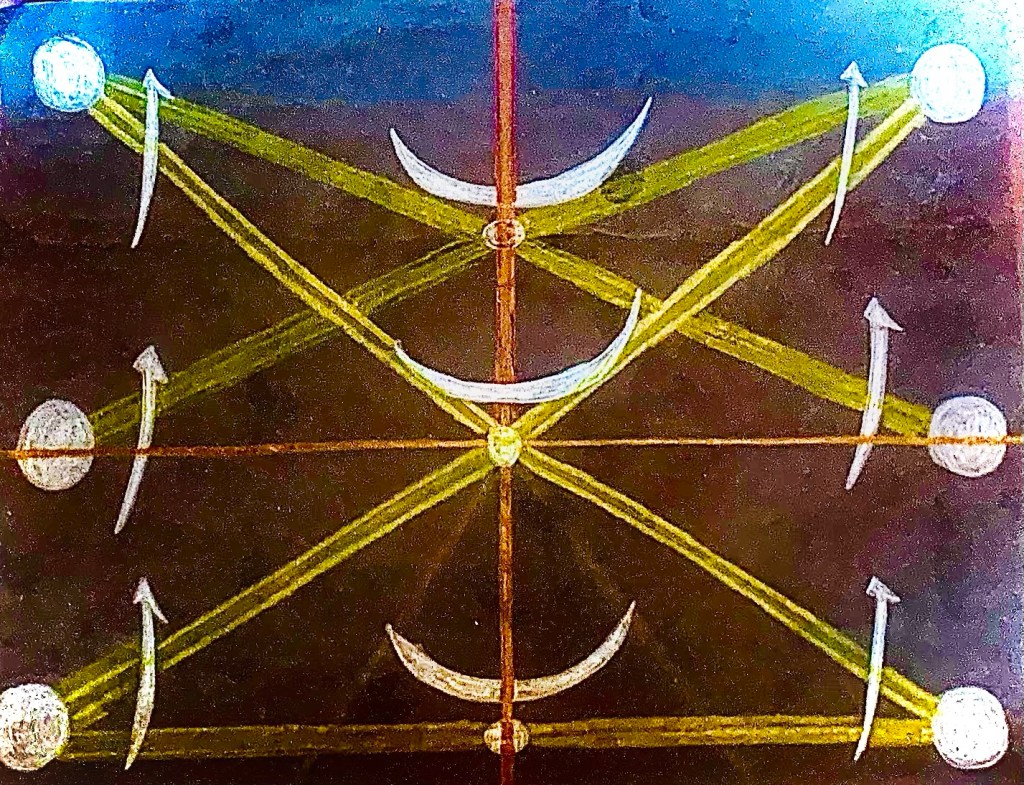
All direct quotes are from Shuayb Eric Winkle’s translation published by Pir Press
*
Ibn Arabi writes In Book 2 Chapter 13 of The Futuhat, Bearers of The Throne: “Learn, may God assist the sincire friend, that the Throne in the Arab language is applied to and means the kingdom (Mulk). You say, ‘The king’s throne is overthrown,’ when some incursion has entered his kingdom. And it is applied to and means the elevated seat. If throne is an expression for the kingdom, then the ones who bear him are the staunch supporters of the kingdom; and if ‘throne’ is an expression for the elevated seat, his bearers are the ‘legs’ who stand him up, or the ones who bear him on their upper backs. Numbers enter into the bearers of two thrones. The Messenger deemed their effective force in the world to be four, and on the Day of Arising, eight. Then he said, ‘And today they are four’ – meaning, today in this transitory world; and His word on that day, eight means the Day of the other world.”
*
Ibn Arabi quickly orients us to the image of the throne here and tells us where it is and its meaning, it is the kingdom (mulk). We immediately have the notion of a sovereignty, a sacred place, and then of the ‘stanch supporters of the kingdom’ as the ‘legs’, pillars, or poles that keep the throne ‘standing.’ This is an active image that unlike the connotation of Mulk as a cosmological level seems to extend in its ‘standing’ bore upon the ‘legs’ of its supports throughout the possible worlds. This becomes clearer when we hear that there are in fact two thrones, a dualitude that is echoed throughout the remainder of the chapter when discussing the difference between the organic body and the organic light body, the prophets as supports and the angels as supports, each representing the kingdom their bodies indicate. “Numbers enter into the bearers of two thrones.” The ‘standing’ imagery is used throughout The Futuhat to remind the reader of how the soul ‘stands up’ from the grave after the second blow of Israfil’s horn on the Day of Resurrection. It is in fact the Whole (Perfect) Human Being that embodies both the angelic nature of its being and the elemental nature of its being that stretches and ‘stands’, like this throne in its doubled nature, across the worlds and cosmological levels becoming a bridge for those that will attempt to cross, either through death or through initiation.
*
The active nature of this image having ‘legs’ and ‘standing’ seems to bring us into the arena of the potency of the divine names becoming acts. So although we are in the intelligible realm, and also archetypal realm we are also bridged into the world of action by the supports, again indicating that the doubled throne, or two thrones, have the talismanic effect of linking previously described impassable barriers. As agents of divine potency becoming ‘acts’ or manifestation sites for the names to alight we see how the Kingdom and its sovereign and supports can form a unitude. This unity, though it intersects the worlds does not represent the entirety of each worlds possibilities, for there is also the portion of the wretched. This image of the thrones and its supports represents the unity of a sovereignty regained or reestablished in the world of acts, no longer hidden from its imaginal and intelligible reality, both a reflection of and extension of its power and reality appearing now in the elemental world. The fusion of the two thrones becomes the image of the archetypal temple, the Kabbah, and the whole human being as the knight of the temple, or resident attendant of the temple, both the angel and person that circles and inhabits it.
*
Later in The Futuhat we learn that while the imagery indicates that Allah sits upon the throne that there is a paradoxical way of understanding that people can be carried or “bore” or “borne” upon this throne. One possible function of this throne is that people in need can be carried or ferried across troubled times or waters to arrive safely at their destination. This suggests the idea of ‘throne riders’ similar to the tradition in Kabbalistic circles of the ‘merkavah riders.’ This possibility further confirms the potent use of the Throne in contemplative imagery as a place of protection and initiation. By contemplating the ‘imaginal blueprints’ of the thrones and working relationally with their supports one can construct an ‘opening’ into the Kingdom, and by entering into it one proclaims one’s allegiance to its purpose, to support and participate in the unification of the divine world. To further enter into this sovereign imagery we can also think of those who participate with this image as ‘knights’ of the temple, those staunch supporter who through a commitment to the ethics of spiritual chivalry, become participants in the ‘inner’ kingdom. One important differentiation here is the difference between the inner and outer kingdoms. A quick example being a knight that serves an earthly queen and country and one who serves both from an inner approach; clearly the inner approach is much more rigorous because contact with these realities must be made for there to be active participation, communication, love, and knowledge. Again for the inner contemplative, they must construct these two thrones from the ‘imaginal blueprints’ and enliven them with the help of the supports.
*
The last part of this introductory paragraph is especially important as we engage the numbers of the bearers and the worlds they represent but also link:
“The Messenger deemed their effective force in the world to be four, and on the Day of Arising, eight. Then he said, ‘And today they are four’ – meaning, today in this transitory world; and His word on that day, eight means the Day of the other world.”
We are again brought into the world of acts and movement by the term ‘effective force’ and again we find a differentiation between two worlds, the transitory world (one of change, birth and death) and the other world (where things persist) as is the nature of light.”
*
Ibn Arabi continues to identify and name the supports of this world and the other in the next paragraph:
“We narrate from Ibn Masarrah al-Jabali, one of the greatest people on the path of knowledge, spiritual states, and kasha: ‘The Throne which is borne is the kingdom, and it is bounded in body, spirit, nourishment, and step level.’ So Adam and Israfil are for the forms, Gabriel and Muhammad are for the spirits, Mikail and Abraham are for the sustenance, and Malik and Ridwan for the promise and threat.”
Here we find the supports or ‘legs’ of the thrones named clearly. Regarding the ‘imaginal blueprints’ one can see that the transitory world would have the four as: Abraham, Adam, Muhammad, and Ridwan and the other world throne has Israfil, Gabriel, Mikail, and Malik.
*
“…..its being borne is an expression for the supporters who manage the kingdom.
A manager is elemental form (Adam) or light form (Israfil). Spirit is a manger for elemental form, and spirit is a manger subjugated to light form. Nourishment is for elemental form, and nourishment is knowledge and Maria for the spirits. Rank is physical, such as happiness in entering the Garden; and rank is physical, such as wretchedness in entering Johanna, and rank is based on spirit and on name.”
*
Here we are introduced to the differentiation between elemental form, designated but the prophets, and light form, designated by the angels. Here we may consider that the two thrones are similar in differentiation, one for the transitory world, bore by the prophets in their elemental form, and one intelligible light based throne borne by the angles or spirits of light. But it is not that simple. It would be if the list of the bearers were four prophets and four angels but you may notice that the dyad Malik/Ridwan is for two angels so we must add this mystery our contemplation. The key to this novelty in the blueprint is described above by showing how the dyad Malik/Ridwan act as gates to the Garden and Jahannam. This ‘function’ of the doubled thrones suggests a new mechanism or ‘action’ that occurs in the presence of the throne and its supports, and gives us a new way to understand or contemplate what may occur for those “borne” or “bore” by the throne or those who support the ‘standing’ throne. Later in section three when I present a way to contemplate this structure I will present the notion that one ‘leg’ of each throne is actually a door or opening to another world, the throne of light has a door to paradise, and the throne of elemental matter has a door to Jahnnam. One might think that this door swings one way and is for those “borne” by the throne but another way of conceptualizing the function is to see how that when we are in the presence of the thrones themselves that there may be movement between the step-levels, worlds, and dimensions. Similarly this new focus on the number three allows us to understand the new tertiary or threefold differentiation added by Ibn Arabi when he describes how: “Spirit is a manager for elemental form and spirit is a manger subjegated to light form.” The tertiary structure here is light form, spirit, and elemental form. So we have relinquished our clarity of the dualitude of two thrones and two types of supports into the complexity of a ternary, and yet there is hope that this new apex will lead us to the nourishment we long for.
*
The next two paragraphs in the chapter will help us further differentiate these categories, beings, and realities, and will bring clarity and also mystery into our attempt to build this structure in contemplation, in exegesis, in the place that is no place, for the knight of no-where, for doors and bridges that are not supposed to exist, for seas that are not supposed to meet.
*
“This chapter is built on four kinds: the first kind is form, the second is spirit, the third is nourishment, and the fourth is rank – and it is the end point: Garden or Fire. Each kind is divided into two divisions, so they make eight. They are the bearers of the kingdom throne – that is, when the eight appear, the kingdom is set up, and there appears, and settles on the throne its king.
The first kind, the form, is divided into two divisions: an elemental, organic bodily form, including an imaginal bodily form; and another division, an organic bodily-light-form. Let us start with the body-light and say: The first organic bodies created by God were the spirit-body- angelic ones enraptured by the Majesty of God. Among them were the First Intellect and the All-Soul, with the All-Soul the light bodies which were created from the light of the Majestic came to an end. Thereafter no angel among these was brought about by any other means than by Him, directly except Soul, who is below Intellect. Each angel created after these comes under the force of Nature. They are from a genus of their orbits which they were created from. They are the orbits’ populations. It is that way for the elemental angels. The last kind of angels are the angles created from the actions of the creatures and their breaths.”
*
He begins with ‘This chapter is built on four kinds’ but he may as well have said the Throne is built of four supports and these are their kinds. And we are also told, or promised that when it is built, the king arrives. What a promise, can you believe it? Would you be willing to assist in setting it up? The description of the quaternity helps us understand the attribution of the four supports to each throne based on the names provided previously. To start with the throne of this world we have Adam for form, Muhammad for spirits, Abraham for sustenance, and Ridwan for rank. The throne of the other world would be: Israfil for form, Gabriel for spirits, Mikail for sustenance, and Malik for rank. In working with the quaternities we can attribute two name to each support, one of light and one of matter, and for contemplation one support in each cardinal direction. Below is a list based on these directions attributing two bearers to each support in each of the cardinal direction:
East: Adam/Israfil
West: Abraham/Mikail
North: RIdwan/Malik
South: Muhammad/Gabriel
*
Further, Ibn Arabi gives us a way to reconcile the three with the two when he says that the organic bodily form includes the imaginal bodily form. He says there are ‘two divisions’ between the bodies, but by describing their division he is really describing their method of unification or addition, because is describing and differentiating between kingdoms and genus he is also giving us the thread which the whole (perfect) human being or throne of the Day of Arising will connect. The natures here of all worlds are connected and rectified by the presence of the throne once it becomes eight which is another way of saying when the upper light body throne comes into harmony of unity with the lower elemental body based throne which includes the imaginal body based throne. The fact that the imaginal body is included in the elemental body is a nice key to the way these two interpenetrate and seed one another reciprocally and yet there is a further need then for them to be joined with the intelligible and the First Intellect yet their blueprints be less than square and the boards less than true.
*
There is a further ternary discussed in this paragraph regarding the births of angels by three distinct means. The “birth” of angels can be considered in light of those “borne” by the throne. The first by God directly, spirit-body-angelic ones, the second under the force of Nature, and the third created form the actions of creatures and their breaths. This added function of the Throne as birther, as womb, connects to the womb like aspects of the name Rahman, who if we build correctly will come to this place to ‘settle,’ as birther, as settler.
*
“They are from a genus of their orbits which they were created from. They are the orbits’ populations. It is that way for the elemental angels. The last kind of angels are the angles created from the actions of the creatures and their breaths.”
*
This a powerful statement about the active participation of the supports and the knights of the temple, the throne bearers, and how their commitment contributes to the continued arrival of new angels. One could say Ibn Arabi is inviting us to people the world with angels by uniting and empowering this lineage and by leaving us traces of how to build this temple and contact its resident diety or dieties. Another way of conceptualizing these images is that they all make up the body of The Complete Human. A human whose body is made of living images, the images as organs.
*
That the last kind of angels are produced by the creatures actions and breaths gives us another hint about the function of the throne contemplation and why towards the later part of the chapter there is a list of the eight names to be used in this contemplation. The use of the word “orbiting” in the end of the this paragraph signals us to focus on the “letters” of the divine names. Previously in the Futuhat the way the letters arrive through a process of tajalli and orbit into elementally combined forms and functions is a fundamental basis of Ibn Arabi’s cosmology. Here we are seeing how the recitation of eight specific divine names can produce breaths and actions which give birth to angels when combined with the active presence of the prophets and archangels as “bearers” or “borners” of the throne. The divine names included by Ibn Arabi and the acts they indicate will help us understand the importance of moral and ethical actions in the world by the contemplator of the throne. For the throne contemplation to be successful there must be actions in the world for the “supports” to arrive in and a place for the divine names to give birth to the “angels.” This indicates that this is a contemplative practice that includes a large part of embodied action as well and a commitment to ethical living based on the supports of the qualities of the divine names, the beings of the prophets and archangels, and the presence of the One who settles on the throne.
*
“I have clarified for you the meaning of the eight, which is the sum of the kingdom, expressed by the ‘Throne’. This is the fourth kind, so then I have clarified for you the meaning of the eight (angelic spirit beings). These eight are related to the eight adjectives by which the True is described. They are the adjectives Living, Knowing, Powering, Desiring, Speaking, Hearing, Seeing, and Perceiving – of taste, smell, touch, by the appropriate adjectives, because belonging to this perception are connections (to the divine adjectives), like the perception of hearing connected to the audible Hearing and sight to the visual Seeing. In this way, the Kingdom is confined to the eight, and the visible of the kingdom in this world are four: form, nourishment, and two ranks; and on the Day of Arising the eight will appear combined before your eyes. It is His word, Bearing the Throne of your Lord above them on that day eight.”
*
In this paragraph Ibn Arabi expands upon the blueprints for constructing the Throne in contemplation and by including the eight adjectives gives us a way to add the practice of dhikr to our contemplative imaginal building approach. The recitation of the divine names inspires the breaths and actions of the creature to “bear” new angels or light based bodies to Paradise of Jahannam. He says that the eight angel spirit beings (the prophets and archangels) are related to the eight adjectives. Due to this direction it is possible to attribute two names to each of the 4 supports. Below I will list an approach to this based on the use of the four cardinal directions:
East: Living Al- Hayy, Knowing Al-Alim
West: Powering Al-Qadr, Desiring Al-Murid
North: Speaking Al-Qail and hearing Al-Sami
South: Seeing Al-Basir and Perceiving Al-Wajid
*
Previously we have illustrated how each of the four supports has two bearers assigned to them; one prophet and one archangel for three supports, the fourth being the gates of Paradise and Johannam presided over by Malik and Ridwan. I will repeat it here for ease of reference: The description of the quaternity helps us understand the attribution of the four supports to each throne based on the names provided previously. To start with the throne of this world we have Adam for form, Muhammad for spirits, Abraham for sustenance, and Ridwan for rank. The throne of the other world would be: Israfil for form, Gabriel for spirits, Mikail for sustenance, and Malik for rank. In working with the quaternities we can attribute two names to each support, one of light and one of matter, and for contemplation one support in each cardinal direction.
*
East: Adam/Israfil
West: Abraham/Mikail
North: RIdwan/Malik
South: Muhammad/Gabriel
*
By combining these blueprints for building the contemplative image we arrive at this combined list:
East: Adam/Israfil, Living Al- Hayy, Knowing Al-Alim
West: Abraham/Mikail, Powering Al-Qadr, Desiring Al-Murid
North: Ridwan/Malik, Speaking Al-Qail and Hearing Al-Sami
South: Muhammad/Gabriel, Seeing Al-Basir and Perceiving Al-Wajid
*
By joining the throne supports of this world and the throne supports of the other world the contemplator assists in building a contemplative space where the four becomes eight and moves into the time and space of the day of arising. By adding the eight adjectives the contemplator enlivens the throne to “move” “bear” “borne” the spirits, to turn potency into acts by engaging the energy of the orbiting letters that make up the divine names.
*
The promise of Ibn Arabi is, “on the Day of Arising the eight will appear combined before your eyes.” This moment is an inner time and space when the construction and joining of these two thrones are complete. The key to understanding the “arising” of sprits and bodies is the support of Malik/Ridwan in the North. This support functions as two doors into two special worlds that of Paradise and Jahannam. From an exoteric sense this deals with the felicitous house or wretched house but from an inner sense or alchemical sense these are portals to spiritual water or fire, fine raiments that indicate different awakening or initiations of the holy spirit. This inner movement of Spirit allows spirits that are stuck or lost in the wrong world to find their proper place, resulting in a healing, a balancing, of the worlds and their residents, the establishment of the Kingdom. The movements of spirits on the day of arising becomes primary here and hint at alchemical mysteries, the purpose and function of the throne, as a resurrection machine.
*
The imaginal blueprints or form and function of the two thrones has been sketched out on the trestle board in some detail here. One thing that we learned is that within the dimensions of this structure there are bi-directional portals or doors to both Paradise and Jahannam. Ibn Arabi tells us that when the two thrones are joined it is the Day of Arising. From an inner standpoint this momentous occasion culminates in the establishment of the Kingdom that unites all cosmological levels, becoming a talismanic bridge or temple like the Kabbah, and the Whole (perfect) human being, as the resident being of this temple is also complete. In an interesting paradox, the description of the moment when God settles on the throne or elevated seat, is also the moment when the Whole Human Being begins to dwell in the completed temple, the sacrosanct house of resurrection. Some keys images here are body, throne, number, temple, legs, standing, supports, angelic birth.
 Illuminist Lodge
Leave a comment